
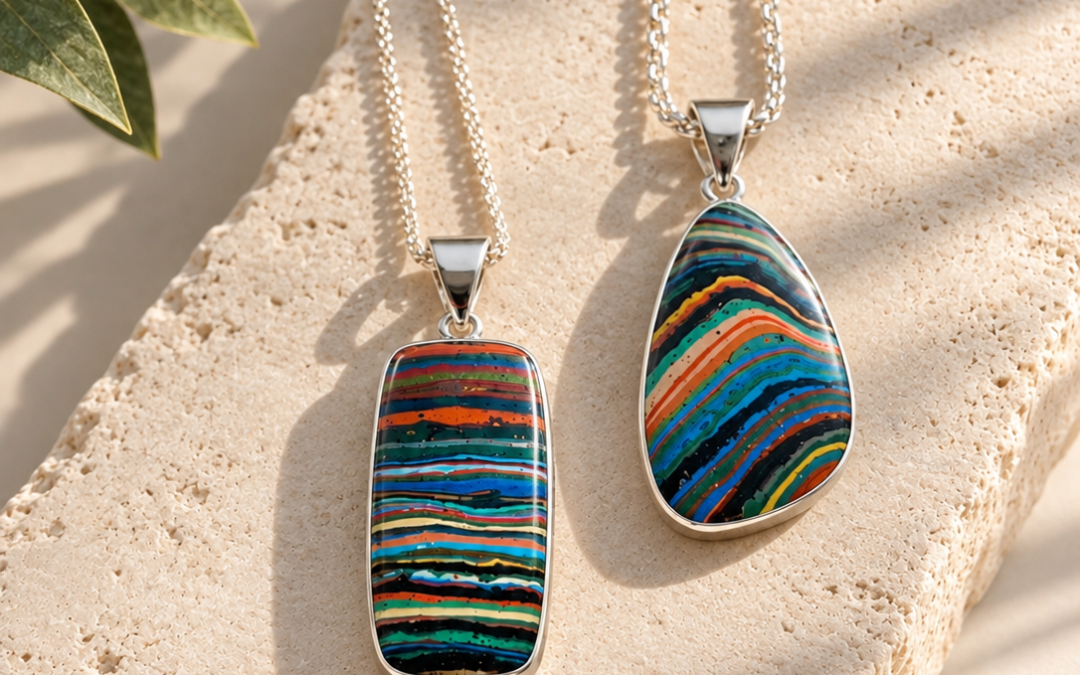
Rainbow Calsilica: Real Stone or Man-Made Mystery?
Few jewelry materials spark as much curiosity as Rainbow Calsilica. With its bold bands of electric blue, vibrant green, sunny yellow, red, and white, it almost looks too colorful to be natural. And that is exactly where the controversy begins.
When Rainbow Calsilica first appeared in the gemstone market in the early 2000s, it was introduced as a rare natural material reportedly discovered in Mexico. Its unusual colors and striking patterns quickly caught the attention of jewelry designers, collectors, and gemstone enthusiasts.
But questions soon followed. Was this really a naturally occurring stone, or was something else responsible for its remarkable appearance?
The debate has continued for years, but scientific testing has given us some important clues.
In This Article
- What Is Rainbow Calsilica?
- The Case for a Natural Stone
- The Case for a Man-Made Material
- What Does the Science Say?
- So, Is Rainbow Calsilica Real?
- Frequently Asked Questions
Quick Summary
Rainbow Calsilica is a colorful material that was originally promoted as a naturally occurring stone from Mexico. However, gemological investigations, including testing discussed in the Gemological Institute of America’s Gems & Gemology, found evidence of crushed carbonate rock, synthetic pigments, and a polymer-like binder. The available scientific evidence strongly supports the conclusion that Rainbow Calsilica is manufactured rather than naturally formed.
What Is Rainbow Calsilica?
Rainbow Calsilica is an opaque, multicolored material often cut and polished into cabochons for jewelry. Its defining feature is its dramatic color banding. Unlike many traditional gemstones, which tend to display more subtle variations in color, Rainbow Calsilica is known for its sharply defined stripes and vivid combinations.
The name itself is interesting. Despite the word “silica,” testing has identified calcite, a form of calcium carbonate, as a major component of the material.
Its unusual appearance made it especially appealing for statement jewelry. The saturated colors offer something different from traditional gemstones, and every polished piece can have its own pattern.
But where did it come from?
The Case for a Natural Stone
When Rainbow Calsilica first entered the market, it was reportedly described as a natural formation found in seams or veins within volcanic rhyolite rock in Chihuahua, Mexico.
The story suggested that the colorful material had formed naturally through geological processes, with different minerals contributing to its bands of color.
Nature certainly has a history of producing extraordinary color combinations. Minerals can form in layers, fill cracks and cavities, and develop striking patterns over long periods of time. The existence of colorful natural stones is not unusual in itself.
Some sellers and collectors continued to defend Rainbow Calsilica as a natural discovery, and the story of a rare Mexican source became part of its appeal.
It is easy to understand why the explanation caught on. A naturally occurring stone with such vivid colors would be an exciting find.
However, a compelling origin story is not the same as scientific proof.
The Case for a Man-Made Material
As Rainbow Calsilica became more widely known, gemologists began investigating its unusual composition.
In a 2002 report published in Gems & Gemology, researchers examined samples of the material and found evidence that challenged the natural-stone explanation.
Their testing identified synthetic pigments and a polymer-like substance. The researchers concluded that the samples appeared to consist of pulverized carbonate rock mixed with pigments and stabilized with a polymer.
Further investigations by gemological laboratories identified artificial coloring agents, including pigments used in artists’ materials, as well as resin between the calcite grains.
These findings are significant because the combination of manufactured pigments and polymer binder is inconsistent with the claim that the material’s distinctive color bands formed naturally as a geological deposit.
In other words, the material may contain natural mineral ingredients, but the finished product is manufactured.
What Does the Science Say?
The strongest evidence comes from laboratory analysis rather than appearance or marketing descriptions.
Here are some of the findings that changed the conversation:
- Calcite was identified: The material contains carbonate mineral grains, primarily calcite.
- Artificial pigments were detected: Testing identified synthetic coloring agents responsible for some of its vivid colors.
- Polymer was found: A plastic-like binder was used to hold the material together and stabilize it.
- The natural origin claim was challenged: The laboratory findings did not support the idea that the distinctive colored material formed naturally in volcanic rock.
The Gemological Institute of America reported on the examination of Rainbow Calsilica samples in its Winter 2002 issue of Gems & Gemology. Later educational discussions by organizations such as Gem-A have also described Rainbow Calsilica as a manufactured material.
Taken together, the evidence makes a strong case for a man-made origin.
So, Is Rainbow Calsilica Real?
Here is where the conversation gets interesting.
If by “real” we mean a naturally occurring gemstone that was mined in its colorful, banded form, the available scientific evidence says no.
If by “real” we mean an actual material used to create jewelry, then absolutely.
Rainbow Calsilica is not simply imaginary, nor does its manufactured origin mean it has no place in jewelry design. It is a composite material made using mineral components, pigments, and a binder. Its appeal comes from its dramatic appearance, not from being a rare natural gemstone.
There is also an important distinction between a man-made material and a fake. A material can be manufactured and still be a legitimate design choice. The problem arises when its origin is misrepresented.
For jewelry shoppers, transparency matters. Knowing whether a piece contains a natural gemstone, a treated stone, or a manufactured composite helps buyers understand exactly what they are purchasing.
Frequently Asked Questions
Is Rainbow Calsilica a natural gemstone?
Scientific testing has found that Rainbow Calsilica is a manufactured composite containing calcite, artificial pigments, and polymer. It is not supported as a naturally occurring gemstone.
Where does Rainbow Calsilica come from?
It was originally marketed as a natural material from Chihuahua, Mexico. However, laboratory investigations challenged that origin story and found evidence of a manufactured composition.
What is Rainbow Calsilica made of?
Testing has identified pulverized carbonate material, primarily calcite, combined with synthetic pigments and a polymer-like binder.
Is man-made jewelry material necessarily fake?
Not at all. Man-made materials can be used intentionally in jewelry and art. What matters is that the material is accurately described so buyers understand its composition and origin.
Can Rainbow Calsilica still be used in jewelry?
Yes. Its vivid colors and distinctive patterns can make it an interesting choice for statement jewelry. As with any material, buyers should understand its composition and care requirements.
The Final Verdict: Beauty or Geology?
Rainbow Calsilica may not have the natural origin story that first made it famous, but its unusual appearance still gives it a place in the conversation about jewelry materials.
The real lesson is that not everything that looks like a gemstone is necessarily formed by nature. And not everything manufactured should be dismissed as having no value.
We believe knowing the story behind a material makes appreciating it even more interesting. Whether you are drawn to the colors, the craftsmanship, or the science behind it, Rainbow Calsilica is a reminder to look a little closer and always ask questions.
What do you think? Does knowing Rainbow Calsilica is man-made change how you view it, or does its appearance speak for itself?
Visit us online at trailsonfalls.com or in person at Trails on Falls, Camperdown Plaza, 320 Falls St., Suite D, Greenville, SC 29601.